Why Choose This Lemosho Route Climb
- Scenic Beauty: Remote and less crowded route with stunning views and diverse ecosystems.
- Best Acclimatization: Gradual ascent profile with excellent success rates for summit achievement.
- Wildlife Encounters: Start through rainforest with chances to see wildlife before entering alpine zones.
- Expert Support: Professional guides and porters ensuring safe and comfortable journey.
Welcome to our comprehensive guide for the Lemosho Route 8 Days | Kilimanjaro Climbing Package. This itinerary represents the pinnacle of adventure travel in Tanzania, offering an unmatched combination of world-class wildlife viewing, dramatic natural landscapes, and professional support teams dedicated to your safety and enjoyment throughout the entire journey. Whether you are seeking a challenging trek or a relaxing safari, our expert team ensures every detail is managed with precision.
Lemosho Route 8-Day Pricing
$2,350 – $3,100 USD
Per person, based on group size; private departures available
High Success RateAll-InclusiveFree Airport Transfer
- Summit Africa's highest peak with expert guides
- Experience five distinct ecological zones
- Professional acclimatization for safety
- Quality camping equipment and meals included
Experience an unforgettable climbing adventure with Generous African Safari & Tours Tanzania. Our expertly crafted itineraries combine wildlife encounters, cultural immersion, and breathtaking landscapes for a truly authentic African experience.
Mount Kilimanjaro High Success Rate climbing route specifications:
- Duration: High Success Rate
- Start & End: Moshi or Arusha, Tanzania
- Accommodation: High-quality mountain camping tents
🏔
Remote, low-traffic western approach through pristine rainforest
🏔
Crossing of the expansive Shira Plateau
🏔
Barranco Wall scramble and views into the Western Breach
🏔
Extended acclimatization for one of Kilimanjaro's highest success rates
🏔
Summit via Stella Point to Uhuru Peak, Africa's rooftop
- Day 1: Londorossi Gate to Mti Mkubwa (Forest Camp)
- Day 2: Mti Mkubwa to Shira 1 Camp
- Day 3: Shira 1 to Shira 2 Camp
- Day 4: Shira 2 to Barranco Camp (via Lava Tower)
- Day 5: Barranco Camp to Karanga Camp
- Day 6: Karanga Camp to Barafu Camp
- Day 7: Barafu Camp to Summit to Mweka Camp
- Day 8: Mweka Camp to Mweka Gate
Day 1
Londorossi Gate to Mti Mkubwa (Forest Camp)
6km · 3-4 hrs · Meals: L, D
After registration at Londorossi Gate (2,100m), a short 3-4 hour trek through dense pristine rainforest leads to Mti Mkubwa ("Big Tree") Camp at 2,780m. This remote western approach sees far fewer climbers than other routes, offering excellent wildlife-spotting opportunities in the lower forest zone. The camp is named for a massive ancient podocarpus tree nearby. This is a gentle introduction day with only 680m of elevation gain, allowing your body to begin adjusting to altitude gradually. The crew sets up camp while you rest, and dinner is served in the mess tent.
🔥 HIGHLY ANTICIPATED SUMMIT DAY
Day 2
Mti Mkubwa to Shira 1 Camp
8km · 5-6 hrs · Meals: B, L, D
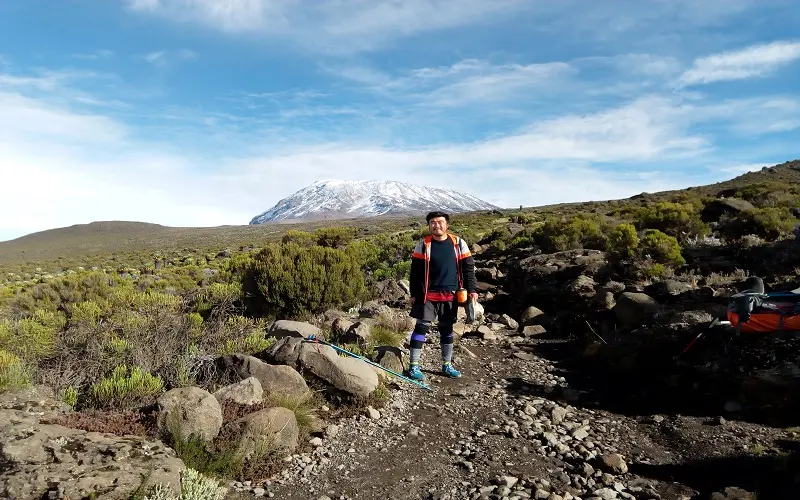
The forest thins into open moorland as the trail climbs onto the edge of the Shira Plateau, camping at Shira 1 (3,505m). Today's hike covers 5-6 hours with 725m of elevation gain. The landscape transforms dramatically as you emerge from the trees into a world of heather, giant groundsel, and lobelia plants. Views open up across the Shira Plateau, a vast volcanic plain that feels like another planet. This is your first night above 3,500m, and your guide will monitor everyone closely for altitude adjustment. The sunset views from camp are spectacular, with Kibo's summit visible on the horizon.
Day 3
Shira 1 to Shira 2 Camp
6km · 3-4 hrs · Meals: B, L, D
An easier day crossing the plateau itself, with wide views toward Kibo's summit, ending at Shira 2 Camp (3,850m). The hike is only 3-4 hours with 345m of elevation gain, giving your body valuable time to acclimatize. The Shira Plateau is a vast, almost otherworldly landscape of volcanic rock and alpine vegetation. You'll have the afternoon to rest, explore the area around camp, and prepare for the more challenging days ahead. This gentle day is a key part of Lemosho's high success rate — it allows for better altitude adjustment before the summit push.
Day 4
Shira 2 to Barranco Camp (via Lava Tower)
10km · 6-7 hrs · Meals: B, L, D
A "climb high, sleep low" day up to the Lava Tower (4,600m) before descending into the Barranco Valley (3,960m). The climb to Lava Tower takes 3-4 hours through increasingly barren alpine desert where the thin air is noticeable. After a brief rest at the tower, you descend 640m into the lush Barranco Valley, surrounded by towering senecio plants. Total hiking time is 6-7 hours with significant altitude variation that helps acclimatization. Barranco Camp is one of the most scenic on Kilimanjaro, nestled below the dramatic Barranco Wall with stunning views.
Day 5
Barranco Camp to Karanga Camp
5km · 4-5 hrs · Meals: B, L, D
The Barranco Wall scramble opens the day — a hands-on-rock section for about an hour, though no ropes or technical skills are needed. Your guides assist you step by step. After the wall, the trail undulates across several ridgelines with stunning views before the shorter crossing to Karanga Camp (3,995m). The hike is 4-5 hours today with only 35m of elevation gain, allowing for rest and recovery. Karanga Camp sits on a ridge with dramatic views down into the valley. This is an important rest day before the summit push, and you'll have the afternoon to hydrate and mentally prepare.
Day 6
Karanga Camp to Barafu Camp
4km · 3-4 hrs · Meals: B, L, D
A short, steady climb onto the summit-approach ridge, arriving at Barafu Camp (4,640m) for rest ahead of the summit push. The hike is only 3-4 hours with 645m of elevation gain, intentionally short to conserve energy. Barafu Camp is barren and exposed, positioned strategically for the midnight summit attempt. The afternoon is spent resting in your tent, hydrating, and preparing gear. Dinner is served early around 5:00 PM, and your guide conducts a detailed briefing on summit strategy. Most climbers try to sleep by 7:00 PM, though anticipation makes this difficult.
🔥 HIGHLY ANTICIPATED SUMMIT DAY
Day 7
Barafu Camp to Summit to Mweka Camp
17km · 11-15 hrs · Meals: B, L, D
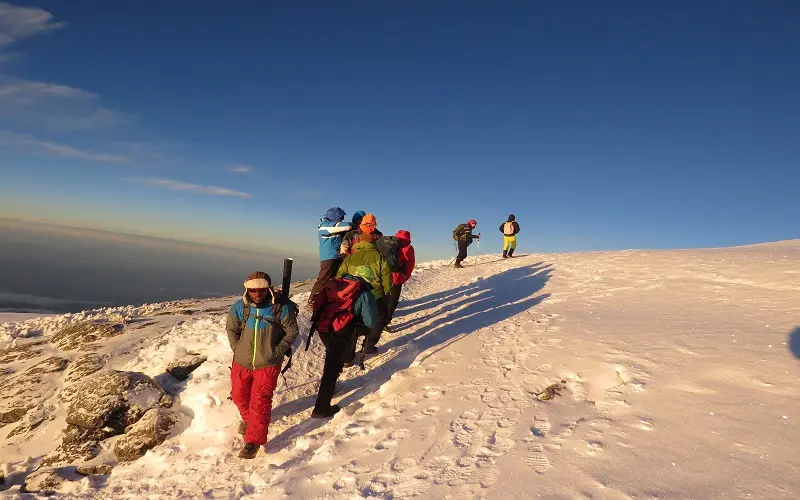
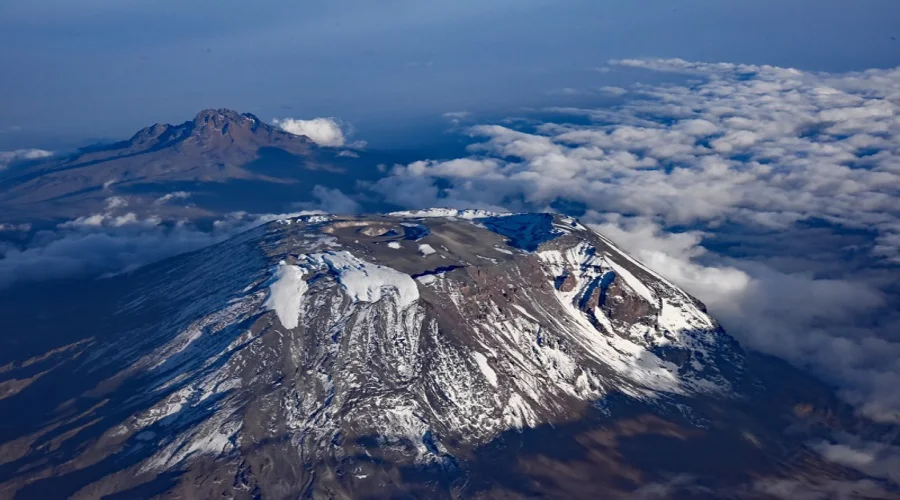
A midnight start for the summit via Stella Point to Uhuru Peak (5,895m), then a long descent to Mweka Camp (3,100m). The ascent under headlamp takes 6-8 hours to Stella Point (5,685m) on the crater rim, then another hour to Uhuru Peak — Africa's highest point. The sunrise from the summit is unforgettable, with glaciers glowing gold and the curvature of the earth visible. After celebration and photos, the long descent begins. Total hiking time is 12-14 hours, making this the most demanding day of the climb. At Mweka Camp, a hot meal and well-earned rest await.
Day 8
Mweka Camp to Mweka Gate
10km · 3-4 hrs · Meals: B, L
Descend through rainforest to Mweka Gate for certificates and transfer back to your hotel. The 3-4 hour walk is a celebration as you return to lush vegetation and lower altitude. At the gate, you'll receive your official Kilimanjaro National Park certificate. A vehicle transfers you back to your hotel in Moshi or Arusha, where a hot shower and proper bed await. The sense of accomplishment is immense, and most climbers spend the evening recounting highlights from the week with their trekking mates.
Park entry, camping, and rescue fees
Professional guides, cooks, and porters
All meals on the mountain
Mountain tents, mess tent, and camping equipment
Airport transfers and pre/post-climb hotel night(s)
Bottled/treated drinking water on the mountain
International flights and Tanzania visa fees
Personal trekking gear and clothing
Tips for guides, cooks, and porters
Travel insurance with evacuation cover
Alcoholic and personal beverages
🕵️♂️
KPAP & Local Experts
Our guides have 10+ years of tracking experience, knowing exactly where the wildlife migrates and how to escape the crowds.
🚙
Custom 4x4 Vehicles
Travel in safety with custom-modified Toyota Land Cruisers featuring charging ports, large windows, and a pop-up roof.
⭐
Tailored Hospitality
We handpick clean, high-service safari lodges and luxury camps, ensuring delicious meals and excellent comfort after game drives.
The best time to climb Mount Kilimanjaro is during the dry months of January-March and June-October, when the weather is stable with less rain.
Peak season
Good season
Low / rainy season
FAQ
Why is Lemosho considered the best Kilimanjaro route?
Its longer distance, gradual altitude gain, and remote scenery combine for both strong success rates and a quieter trekking experience.
FAQ
Is Lemosho harder than Machame?
Physically similar, but Lemosho's extra days make each day's altitude gain gentler, which most climbers find easier overall.
FAQ
How crowded is this route?
Notably less crowded than Machame or Marangu, especially in the first two days.
FAQ
Do Lemosho and Machame routes ever cross?
Yes, they merge near the Lava Tower/Barranco Camp area on day 4.

 Moshi, Tanzania
 +255 742 596 234
 generoustours@gmail.com